Advice
How much loft insulation does a new build have?
There is no set depth. The government's guidance under the building regulations gives a new home's roof a limit on how much heat it lets through, not a thickness.
Round here, about 6 in 10 certificates for homes built since 2012 that give a figure put the roof at 0.11 or better. On the energy assessors' own table, that is what 400mm or more of mineral wool gives. Where an assessor has measured a newer loft, a typical one reads 300mm.
Do building regulations say how deep new build loft insulation must be?
No. The guidance sets a heat loss figure for the roof, called a U-value, and leaves the depth to the designer.
A U-value is how much heat a roof lets through. Lower is better. Approved Document L, the government's guidance on the energy rules, sets two figures for a new home's roof:
- 0.16: the limit every new roof must meet.
- 0.11: the roof of a yardstick house the design is compared against.
For the whole home to pass, some parts will need to be significantly better than the limits.
That edition took effect on 15 June 2022. Homes whose plans went in before then could still be built to the older edition, if work on each one started before 15 June 2023. Earlier versions still apply to buildings that come under earlier standards.
The figure 270mm does not appear in the document. It is the Energy Saving Trust's, which calls it "the minimum recommendation for new builds". When loft insulation is a legal requirement.
Sources: Approved Document L, Volume 1, 2021 edition with 2023 amendments, tables 1.1 and 4.1; GOV.UK, Approved Document L; Energy Saving Trust, roof and loft insulation. All read 10 November 2026.What does a U-value of 0.11 or 0.16 mean in millimetres?
Roughly 400mm or more of mineral wool for 0.11, and 270mm for 0.16.
The energy certificate method has a table that turns a measured depth into a U-value. For mineral wool laid between and over the joists:
- 270mm gives 0.16
- 300mm gives 0.14
- 350mm gives 0.12
- 400mm or more gives 0.11
So on the assessors' table, 270mm matches the limit and 400mm matches the yardstick.
The table is for mineral wool (or polystyrene). A roof can reach the same figure with a different material at a different thickness. So a U-value does not tell you exactly what is up there. 270mm or 300mm, and the full table.
Source: BRE, RdSAP 10 specification, table 16. Read 10 November 2026.How much insulation do new builds in Cambridgeshire have?
Most certificates show a roof at or better than the yardstick. A few show less than the limit.
We read the certificates for every house and bungalow built from 2012 across our six councils: 44,442 homes. On 40,378 of them, the most recent certificate gives the roof as a U-value, not a depth.
The same calculation is used to show new homes meet the building regulations and to produce their energy certificates. On those certificates, the roof appears as a U-value.
Of those 40,378 certificates:
- about 6 in 10 (24,008) put the roof at 0.11 or better
- about 1 in 3 (13,888) sit between 0.12 and 0.16
- about 1 in 16 (2,482) are above 0.16
Many homes in this group were built to earlier editions of the rules.
Sources: our own count from government energy certificate data, explained on how we work out our figures, run 10 November 2026; GOV.UK, Standard Assessment Procedure, read 10 November 2026.Why does my new build have less than 270mm?
Plenty do, and there are fair reasons. About 1 in 3 newer lofts measured here read under 270mm.
Only a small share of newer homes have had the loft measured. About 1 in 16 of those built from 2012 (2,709 of 44,442) have a depth on their most recent certificate.
A depth in millimetres is what the shorter, lower cost method for existing homes records. So the lofts measured are not a random sample of new builds.
Of those lofts measured, a typical one reads 300mm. More than half (1,501 of 2,709) have 300mm or more. About 1 in 3 (882) have less than 270mm.
A depth under 270mm is not proof that anything was done wrong:
- Every newer loft measured here was built before the current rules applied, under earlier editions.
- Even under today's edition, the whole home is tested against the yardstick. A roof can be worse than 0.11 if other parts make up for it.
- Insulation can be moved or squashed after handover.
- A reading is not a laboratory measurement. In 15,160 of the 62,103 homes assessed twice across the area, the later certificate records a shallower loft than the first.
Has new build loft insulation got deeper over the years?
Yes, step by step. Of the lofts measured in homes built from 1996, each later group has a bigger share at 270mm or more.
A typical loft measured reads 200mm. Only about 1 in 7 have 270mm or more (1,882 of 12,216).
Still 200mm typical. About 1 in 5 have 270mm or more (1,586 of 7,714).
250mm typical. About 4 in 10 have 270mm or more (2,233 of 5,647).
300mm typical. About 2 in 3 have 270mm or more (1,827 of 2,709).
So a home built in the 2000s is not likely to have 270mm, whatever you may read online. Most of the lofts measured from those years have less.
Cambourne is the clearest local case. Almost every home there (3,835 of 3,992) was built from 1996 onwards. The average loft measured reads 228mm, across 1,876 homes with a depth on their most recent certificate. Lofts in Cambourne.
Source: our own count from government energy certificate data, six councils, houses and bungalows, most recent certificate, explained on how we work out our figures. Read October 2026 and run again 10 November 2026.How do I find out how much insulation my new build has?
Look at your energy certificate first, then look in the loft.
- Check the certificate. Our loft checker shows what it records for the roof. A U-value can be turned into a rough depth of mineral wool with the table above. A depth is what the assessor saw on the day. How to read your EPC loft rating.
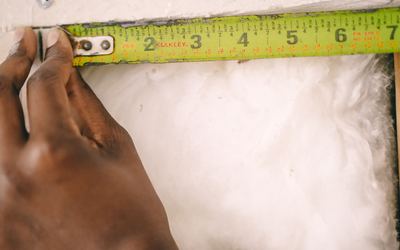
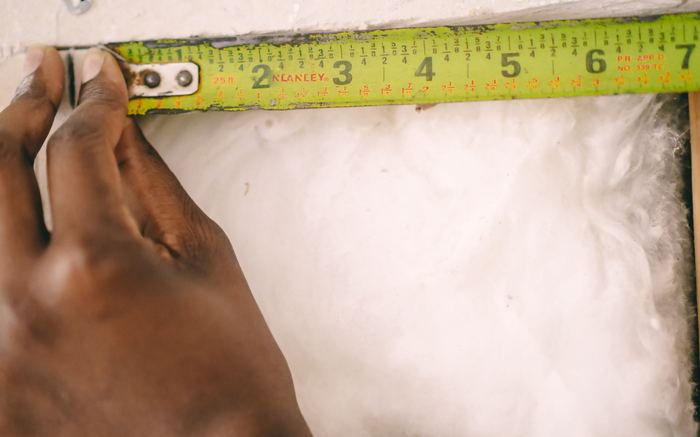
- Then measure. The certificate tells you what was designed or recorded, not what is up there now. A tape measure pushed gently down to the ceiling, from the hatch or a boarded area, shows the real depth.
Do not step between the joists. LABC Front Door warns the ceiling there "cannot take any heavy weight".
Sources: BRE, RdSAP 10 specification, table 16; LABC Front Door, roof insulation. Both read 10 November 2026.Will homes built from 2027 have more loft insulation?
Not by rule. The new edition keeps the same 0.16 limit for a new roof, and still gives no depth.
The 2026 edition of Approved Document L takes effect on 24 March 2027 for most building work in England. Its table of limits for new homes still lists all roof types at 0.16.
The yardstick house is no longer printed in the document itself. It points to the national calculation method's own specification instead.
Source: Approved Document L, Volume 1, 2026 edition, table 3.1. Read 10 November 2026.Can I add more insulation to a new build loft?
Yes, as long as the insulation runs right to the eaves without blocking the airflow, and is not squashed.
- NHBC's standard for homes begun from 2026 says insulation should be laid over the whole loft and the wall plate (clause 7.2.15.3).
- When a new home is built, Approved Document L asks for the insulation at the eaves "without any reduction in thickness due to the pitch of the roof".
- Do not squash mineral wool, because that makes it insulate less well.
Deeper insulation keeps the loft colder. It keeps heat out of the roof space, so the surfaces up there stay cold and the risk of condensation can go up.
A new home can also see roof space condensation in its first heating season, while the building dries out. Why is there condensation in my loft?
Want to use the loft for storage as well? Can you board a loft in a new build?
Sources: NHBC Standards 2026, clauses 7.2.15.1 and 7.2.15.3, re-read 10 November 2026 (they cover homes begun from 1 January 2026); Approved Document L, Volume 1, 2021 edition, paragraph 4.17; Energy Saving Trust, roof and loft insulation; NHBC, condensation in your roof space. All read 10 November 2026.Short answers
Is 400mm too much for a new build loft?
Not for a new build. On the assessors' own table, 400mm or more of mineral wool is what reaches 0.11, the yardstick roof. Each extra layer saves less than the one before, and a deeper layer needs a taller floor if you board over it. Is deeper worth it?
Is 250mm loft insulation enough?
It is short of the 270mm the Energy Saving Trust recommends, though not by much. The assessors' table puts 250mm at 0.17, against 0.16 for 270mm. How much loft insulation do I need?
What roof U-value does a new build have to meet?
A limit of 0.16, with no depth set. That is in Approved Document L, the guidance under the building regulations, in both the current edition and the one that takes effect on 24 March 2027. For existing homes, see loft insulation regulations.
Find out what your new build loft has
A new build has no set depth, and plenty of newer lofts measured here read less than 270mm.
Check what your certificate records, then have a look. If yours is short, we can get your loft insulated to 270mm, and boarded at the same time if you want the space for storage. The survey is free and takes about twenty minutes. You get a written price before any work starts.
Loft insulation top up: from £10 per m².
We reply within 24 hours.

Complete Loft Services sorts out loft boarding, insulation, ladders and hatches across Cambridgeshire and the surrounding counties. The survey is free, and you get a written price before any work starts.
Written by Ben Criddle, who runs Complete Loft Services. Published . Facts checked on .